
K-12 AI Literacy Aligned with
National Standards
Join Family Waitlist For Early $15/m Access + 7-Day Free Trial at Launch.
Don't just prepare them for the future—help them profit from it. Life Hub’s AI curriculum turns kids into confident learners and acheivers who earn rewards as they learn all about AI. Aligned with national standards and built for tomorrow’s leaders, this is where education meets real-world opportunity.

AI Literacy Curriculm For Home,
School & Youth Organizations
Life Hub's AI curriculm enables parents, homeschooler, schools and youth organizations to deliver comprehensive AI literacy. Kids and students will develop a strong foundation in AI principles, understand its ethical implications, and acquire practical skills for AI application and creation, preparing them for future careers and challenges.
21 distinct courses have been expertly designed to develop both foundational AI literacy and advanced skills. The course list is organised into these eight categories:
Nationwide State
Curriculum Alignment
Our curriculum is designed for national relevance. Select your state to see how we align with local educational standards for technology, computer science, and digital literacy.
 Aligned with Alaska Standards
Our curriculum is built upon nationally recognized frameworks like the CSTA K-12 Computer Science Standards and the ISTE Standards. This strong foundation makes it highly adaptable to meet most state-level requirements for technology, computer science, and information literacy.
Key standards covered:
CSTA K-12 CS Standards ISTE Standards for Students
AI Learning Pathway
Kids begin with “What Is AI?”, move into how machines learn and think, progress to practical AI-tool use, and then advance into creation with AI.
The pathway culminates in career readiness, entrepreneurial frameworks, future-studies thinking, and specialised topics.
This scaffolded sequence allows kids to build conceptual understanding, tool-use fluency, and then apply AI in meaningful real-world and career contexts.
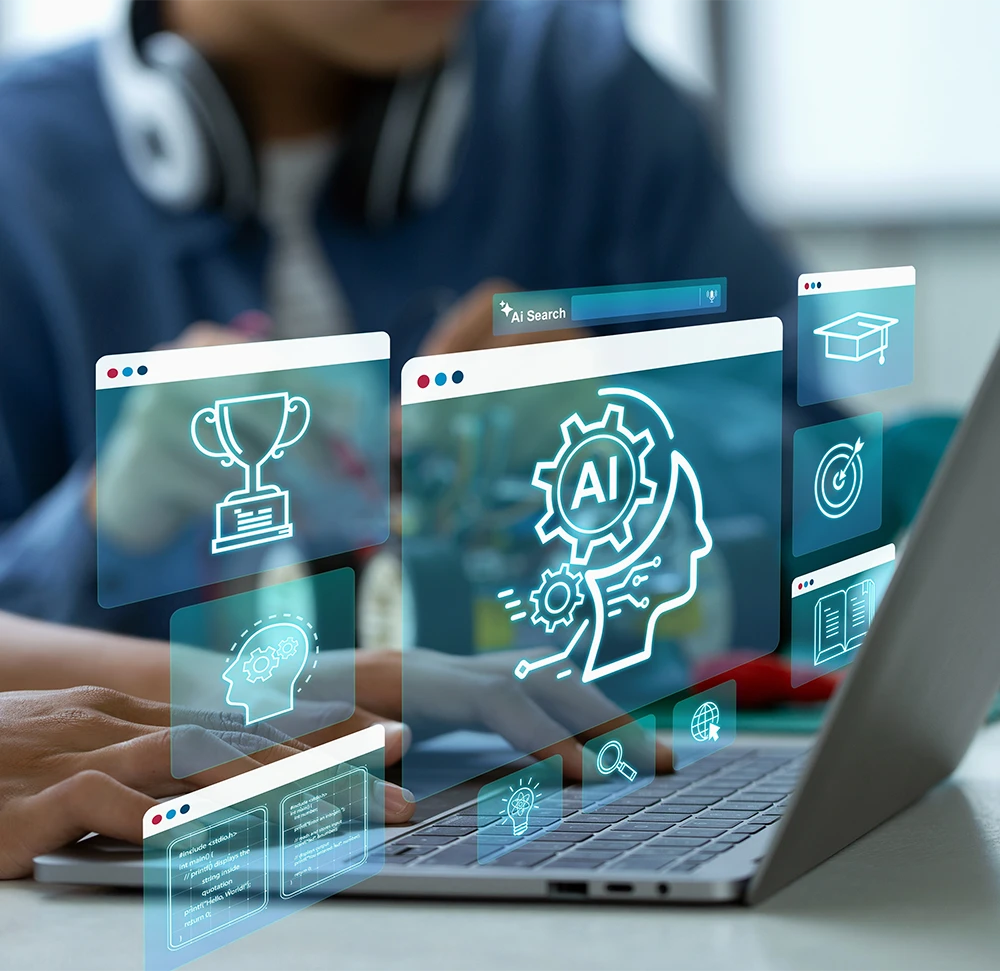

Our 21-Course AI Curriculum
A comprehensive learning journey from foundational concepts to advanced applications, designed for the next generation of innovators.
What Is AI? Foundations of Artificial Intelligence
Learning Outcomes

Define artificial intelligence and identify key examples of AI used in everyday life.
Explain the difference between human intelligence, machine learning, and AI-driven decision making.
Evaluate the ethical and social impacts of AI in modern society.
Why It Matters
AI shapes how we work, learn, and interact—understanding its foundations builds digital literacy for the future.
How Machines Think – Learning, Bias & Ethics
Learning Outcomes
Explain how AI learns through algorithms and data.
Identify examples of bias in AI systems and discuss their societal implications of AI. The learning approach fosters curiosity, playful experimentation, and ethical awareness through relatable scenarios.
Evaluate ethical dilemmas that arise from machine decision-making.
Why It Matters
Understanding how machines "think" builds critical awareness of how data shapes technology outcomes.
Everyday AI Tools
Learning Outcomes
Identify popular AI tools used in communication, creativity, and productivity.
Demonstrate how to use AI tools effectively for writing, image generation, and organization.
Evaluate the pros and cons of relying on AI tools in everyday tasks.
Why It Matters
AI tools are transforming how people learn, work, and express creativity.
Creating with AI
Learning Outcomes
Use AI tools to create digital products such as images, videos, or stories.
Explain how human creativity guides AI outputs.
Reflect on how AI enhances but does not replace original thinking.
Why It Matters
Creativity remains one of the most valuable human skills in an AI-powered world.
AI for School, Work & Life
Learning Outcomes
Apply AI tools to organize schedules, write, and problem-solve effectively.
Demonstrate how AI can support time management, learning, and communication.
Evaluate which AI tools are most useful for specific academic or personal goals.
Why It Matters
AI literacy prepares students for school success and future workplace efficiency.
AI in Careers & Entrepreneurship
Learning Outcomes
Identify emerging AI-driven careers and business opportunities.
Design a simple business idea that leverages AI tools or automation.
Analyze how AI is transforming existing industries.
Why It Matters
AI is opening entirely new career paths across technology, healthcare, business, and beyond.
The Future of AI in Work and Society (Next 5–10 Years)
Learning Outcomes
Predict near-future trends in AI adoption across industries.
Discuss how automation may change jobs and social structures.
Evaluate policies and skills needed to thrive in an AI-augmented society.
Why It Matters
The next decade will redefine how people work, collaborate, and innovate.
AI and Robotics – The Long-Term Future (20–30 Years)
Learning Outcomes
Describe the relationship between AI and robotics in developing autonomous systems.
Imagine and communicate a vision for human-machine collaboration in the far future.
Discuss the potential societal, economic, and ethical implications of advanced robotics.
Why It Matters
Robotics and AI together represent the next major leap in human innovation.
AI Mastermind Level 1
Learning Outcomes
Demonstrate how to use AI prompts effectively to generate targeted outputs.
Apply structured thinking and questioning to guide AI responses.
Evaluate the accuracy and reliability of AI-generated results.
Why It Matters
Strong prompting and evaluation skills are the foundation of effective AI use.
AI Mastermind Level 2
Learning Outcomes
Integrate multiple AI tools to complete complex, multi-step projects.
Develop custom AI workflows for problem-solving or creative design.
Reflect on how to use AI for innovation while maintaining ethical balance.
Why It Matters
Advanced AI literacy enables students to automate, innovate, and lead.
AI In Your World
Learning Outcomes
Identify how AI influences personal life, education, and global systems.
Investigate how AI affects privacy, creativity, and communication.
Develop a personal AI code of ethics and best practices for everyday use.
Why It Matters
AI is not just a tool—it's part of every student's digital environment.
Becoming a Machine Learning Expert
Learning Outcomes
Explain how machine learning models are trained and tested using data.
Compare supervised, unsupervised, and reinforcement learning approaches.
Evaluate how model performance impacts real-world AI applications.
Why It Matters
Machine learning powers the most advanced AI systems in the world.
Understanding Natural Language Processing
Learning Outcomes
Describe how AI processes and generates human language.
Analyze examples of NLP applications such as chatbots and translation tools.
Evaluate the ethical and accuracy challenges in NLP systems.
Why It Matters
NLP is the bridge between human communication and AI understanding.
AI Tools Series – ChatGPT
Learning Outcomes
Demonstrate how to effectively use ChatGPT for writing, brainstorming, and research.
Apply prompting strategies to improve quality and precision of AI responses.
Reflect on ethical considerations and plagiarism risks with AI writing.
Why It Matters
ChatGPT is one of the most widely used AI tools globally for communication and learning.
AI Tools Series – Study Tools
Learning Outcomes
Identify AI tools designed to improve studying, organization, and learning retention.
Demonstrate how AI can summarize, quiz, and guide learning progress.
Evaluate which AI tools best fit individual learning styles.
Why It Matters
AI-powered study tools make learning more accessible and personalized.
AI Tools Series – Art and Design
Learning Outcomes
Use AI tools to generate art, design, and creative visual projects.
Compare human and AI-generated artistic processes.
Discuss ethics and originality in AI art creation.
Why It Matters
AI expands creative potential beyond traditional art methods.
AI Tools Series – DALL·E
Learning Outcomes
Create original AI-generated images using DALL·E.
Apply descriptive prompts to achieve detailed visual outcomes.
Analyze the balance between creative control and algorithmic influence.
Why It Matters
DALL·E represents how imagination meets machine learning in art.
AI Tools Series – Gamma
Learning Outcomes
Use Gamma to generate visual presentations efficiently.
Apply design and narrative structure principles to AI-generated presentations.
Evaluate how AI presentation tools can enhance communication and collaboration.
Why It Matters
Presentation AI tools save time and elevate communication quality.
AI Tools Series – Career and Productivity
Learning Outcomes
Use AI tools for résumé creation, time management, and goal tracking.
Analyze how automation can improve efficiency and organization.
Apply AI strategies to prepare for interviews or professional networking.
Why It Matters
AI enhances personal productivity and career preparation.
AI Tools Series – Gemini
Learning Outcomes
Use Google Gemini to conduct AI-powered research and writing tasks.
Compare Gemini's functions to other AI tools for speed and accuracy.
Evaluate the credibility and ethical considerations of AI-generated research.
Why It Matters
Gemini represents the next evolution of AI-powered search and knowledge discovery.
AI Tools Series – Learning AI Coding
Learning Outcomes
Explain key programming concepts such as algorithms, datasets, and neural networks.
Write and test simple AI models or scripts using beginner coding tools.
Reflect on how coding drives innovation in AI systems.
Why It Matters
Learning to code in AI develops problem-solving and analytical thinking.
AI Tools Series – Study Tools
Learning Outcomes
Identify AI tools designed to improve studying, organization, and learning retention.
Demonstrate how AI can summarize, quiz, and guide learning progress.
Evaluate which AI tools best fit individual learning styles.
Why It Matters
AI-powered study tools make learning more accessible and personalized.
Becoming a Machine Learning Expert
Learning Outcomes
Explain how machine learning models are trained and tested using data.
Compare supervised, unsupervised, and reinforcement learning approaches.
Evaluate how model performance impacts real-world AI applications.
Why It Matters
Machine learning powers the most advanced AI systems in the world.
AI Mastermind Level 2
Learning Outcomes
Integrate multiple AI tools to complete complex, multi-step projects.
Develop custom AI workflows for problem-solving or creative design.
Reflect on how to use AI for innovation while maintaining ethical balance.
Why It Matters
Advanced AI literacy enables students to automate, innovate, and lead.
What Is AI? Foundations of Artificial Intelligence
Learning Outcomes
Define artificial intelligence and identify key examples of AI used in everyday life.
Explain the difference between human intelligence, machine learning, and AI-driven decision making.
Evaluate the ethical and social impacts of AI in modern society.
Why It Matters
AI shapes how we work, learn, and interact—understanding its foundations builds digital literacy for the future.
How Machines Think – Learning, Bias & Ethics
Learning Outcomes
Explain how AI learns through algorithms and data.
Identify examples of bias in AI systems and discuss their societal implications of AI. The learning approach fosters curiosity, playful experimentation, and ethical awareness through relatable scenarios.
Evaluate ethical dilemmas that arise from machine decision-making.
Why It Matters
Understanding how machines "think" builds critical awareness of how data shapes technology outcomes.
Everyday AI Tools
Learning Outcomes
Identify popular AI tools used in communication, creativity, and productivity.
Demonstrate how to use AI tools effectively for writing, image generation, and organization.
Evaluate the pros and cons of relying on AI tools in everyday tasks.
Why It Matters
AI tools are transforming how people learn, work, and express creativity.
Creating with AI
Learning Outcomes
Use AI tools to create digital products such as images, videos, or stories.
Explain how human creativity guides AI outputs.
Reflect on how AI enhances but does not replace original thinking.
Why It Matters
Creativity remains one of the most valuable human skills in an AI-powered world.
AI for School, Work & Life
Learning Outcomes
Apply AI tools to organize schedules, write, and problem-solve effectively.
Demonstrate how AI can support time management, learning, and communication.
Evaluate which AI tools are most useful for specific academic or personal goals.
Why It Matters
AI literacy prepares students for school success and future workplace efficiency.
AI in Careers & Entrepreneurship
Learning Outcomes
Identify emerging AI-driven careers and business opportunities.
Design a simple business idea that leverages AI tools or automation.
Analyze how AI is transforming existing industries.
Why It Matters
AI is opening entirely new career paths across technology, healthcare, business, and beyond.
The Future of AI in Work and Society (Next 5–10 Years)
Learning Outcomes
Predict near-future trends in AI adoption across industries.
Discuss how automation may change jobs and social structures.
Evaluate policies and skills needed to thrive in an AI-augmented society.
Why It Matters
The next decade will redefine how people work, collaborate, and innovate.
AI and Robotics – The Long-Term Future (20–30 Years)
Learning Outcomes
Describe the relationship between AI and robotics in developing autonomous systems.
Imagine and communicate a vision for human-machine collaboration in the far future.
Discuss the potential societal, economic, and ethical implications of advanced robotics.
Why It Matters
Robotics and AI together represent the next major leap in human innovation.
AI Mastermind Level 1
Learning Outcomes
Demonstrate how to use AI prompts effectively to generate targeted outputs.
Apply structured thinking and questioning to guide AI responses.
Evaluate the accuracy and reliability of AI-generated results.
Why It Matters
Strong prompting and evaluation skills are the foundation of effective AI use.
AI Mastermind Level 2
Learning Outcomes
Integrate multiple AI tools to complete complex, multi-step projects.
Develop custom AI workflows for problem-solving or creative design.
Reflect on how to use AI for innovation while maintaining ethical balance.
Why It Matters
Advanced AI literacy enables students to automate, innovate, and lead.
AI In Your World
Learning Outcomes
Identify how AI influences personal life, education, and global systems.
Investigate how AI affects privacy, creativity, and communication.
Develop a personal AI code of ethics and best practices for everyday use.
Why It Matters
AI is not just a tool—it's part of every student's digital environment.
Becoming a Machine Learning Expert
Learning Outcomes
Explain how machine learning models are trained and tested using data.
Compare supervised, unsupervised, and reinforcement learning approaches.
Evaluate how model performance impacts real-world AI applications.
Why It Matters
Machine learning powers the most advanced AI systems in the world.
Understanding Natural Language Processing
Learning Outcomes
Describe how AI processes and generates human language.
Analyze examples of NLP applications such as chatbots and translation tools.
Evaluate the ethical and accuracy challenges in NLP systems.
Why It Matters
NLP is the bridge between human communication and AI understanding.
AI Tools Series – ChatGPT
Learning Outcomes
Demonstrate how to effectively use ChatGPT for writing, brainstorming, and research.
Apply prompting strategies to improve quality and precision of AI responses.
Reflect on ethical considerations and plagiarism risks with AI writing.
Why It Matters
ChatGPT is one of the most widely used AI tools globally for communication and learning.
AI Tools Series – Study Tools
Learning Outcomes
Identify AI tools designed to improve studying, organization, and learning retention.
Demonstrate how AI can summarize, quiz, and guide learning progress.
Evaluate which AI tools best fit individual learning styles.
Why It Matters
AI-powered study tools make learning more accessible and personalized.
AI Tools Series – Art and Design
Learning Outcomes
Use AI tools to generate art, design, and creative visual projects.
Compare human and AI-generated artistic processes.
Discuss ethics and originality in AI art creation.
Why It Matters
AI expands creative potential beyond traditional art methods.
AI Tools Series – DALL·E
Learning Outcomes
Create original AI-generated images using DALL·E.
Apply descriptive prompts to achieve detailed visual outcomes.
Analyze the balance between creative control and algorithmic influence.
Why It Matters
DALL·E represents how imagination meets machine learning in art.
AI Tools Series – Gamma
Learning Outcomes
Use Gamma to generate visual presentations efficiently.
Apply design and narrative structure principles to AI-generated presentations.
Evaluate how AI presentation tools can enhance communication and collaboration.
Why It Matters
Presentation AI tools save time and elevate communication quality.
AI Tools Series – Career and Productivity
Learning Outcomes
Use AI tools for résumé creation, time management, and goal tracking.
Analyze how automation can improve efficiency and organization.
Apply AI strategies to prepare for interviews or professional networking.
Why It Matters
AI enhances personal productivity and career preparation.
AI Tools Series – Gemini
Learning Outcomes
Use Google Gemini to conduct AI-powered research and writing tasks.
Compare Gemini's functions to other AI tools for speed and accuracy.
Evaluate the credibility and ethical considerations of AI-generated research.
Why It Matters
Gemini represents the next evolution of AI-powered search and knowledge discovery.
AI Tools Series – Learning AI Coding
Learning Outcomes
Explain key programming concepts such as algorithms, datasets, and neural networks.
Write and test simple AI models or scripts using beginner coding tools.
Reflect on how coding drives innovation in AI systems.
Why It Matters
Learning to code in AI develops problem-solving and analytical thinking.
AI in Careers & Entrepreneurship
Learning Outcomes
Identify emerging AI-driven careers and business opportunities.
Design a simple business idea that leverages AI tools or automation.
Analyze how AI is transforming existing industries.
Why It Matters
AI is opening entirely new career paths across technology, healthcare, business, and beyond.
AI for School, Work & Life
Learning Outcomes
Apply AI tools to organize schedules, write, and problem-solve effectively.
Demonstrate how AI can support time management, learning, and communication.
Evaluate which AI tools are most useful for specific academic or personal goals.
Why It Matters
AI literacy prepares students for school success and future workplace efficiency.
AI Tools Series – Career and Productivity
Learning Outcomes
Use AI tools for résumé creation, time management, and goal tracking.
Analyze how automation can improve efficiency and organization.
Apply AI strategies to prepare for interviews or professional networking.
Why It Matters
AI enhances personal productivity and career preparation.
AI Tools Series – ChatGPT
Learning Outcomes
Demonstrate how to effectively use ChatGPT for writing, brainstorming, and research.
Apply prompting strategies to improve quality and precision of AI responses.
Reflect on ethical considerations and plagiarism risks with AI writing.
Why It Matters
ChatGPT is one of the most widely used AI tools globally for communication and learning.
AI Tools Series – Gamma
Learning Outcomes
Use Gamma to generate visual presentations efficiently.
Apply design and narrative structure principles to AI-generated presentations.
Evaluate how AI presentation tools can enhance communication and collaboration.
Why It Matters
Presentation AI tools save time and elevate communication quality.
Understanding Natural Language Processing
Learning Outcomes
Describe how AI processes and generates human language.
Analyze examples of NLP applications such as chatbots and translation tools.
Evaluate the ethical and accuracy challenges in NLP systems.
Why It Matters
NLP is the bridge between human communication and AI understanding.
AI Tools Series – Learning AI Coding
Learning Outcomes
Explain key programming concepts such as algorithms, datasets, and neural networks.
Write and test simple AI models or scripts using beginner coding tools.
Reflect on how coding drives innovation in AI systems.
Why It Matters
Learning to code in AI develops problem-solving and analytical thinking.
Creating with AI
Learning Outcomes
Use AI tools to create digital products such as images, videos, or stories.
Explain how human creativity guides AI outputs.
Reflect on how AI enhances but does not replace original thinking.
Why It Matters
Creativity remains one of the most valuable human skills in an AI-powered world.
AI Tools Series – Art and Design
Learning Outcomes
Use AI tools to generate art, design, and creative visual projects.
Compare human and AI-generated artistic processes.
Discuss ethics and originality in AI art creation.
Why It Matters
AI expands creative potential beyond traditional art methods.
AI Mastermind Level 1
Learning Outcomes
Demonstrate how to use AI prompts effectively to generate targeted outputs.
Apply structured thinking and questioning to guide AI responses.
Evaluate the accuracy and reliability of AI-generated results.
Why It Matters
Strong prompting and evaluation skills are the foundation of effective AI use.
How Machines Think – Learning, Bias & Ethics
Learning Outcomes
Explain how AI learns through algorithms and data.
Identify examples of bias in AI systems and discuss their societal implications of AI. The learning approach fosters curiosity, playful experimentation, and ethical awareness through relatable scenarios.
Evaluate ethical dilemmas that arise from machine decision-making.
Why It Matters
Understanding how machines "think" builds critical awareness of how data shapes technology outcomes.
Becoming a Machine Learning Expert
Learning Outcomes
Explain how machine learning models are trained and tested using data.
Compare supervised, unsupervised, and reinforcement learning approaches.
Evaluate how model performance impacts real-world AI applications.
Why It Matters
Machine learning powers the most advanced AI systems in the world.
AI Tools Series – DALL·E
Learning Outcomes
Create original AI-generated images using DALL·E.
Apply descriptive prompts to achieve detailed visual outcomes.
Analyze the balance between creative control and algorithmic influence.
Why It Matters
DALL·E represents how imagination meets machine learning in art.
Everyday AI Tools
Learning Outcomes
Identify popular AI tools used in communication, creativity, and productivity.
Demonstrate how to use AI tools effectively for writing, image generation, and organization.
Evaluate the pros and cons of relying on AI tools in everyday tasks.
Why It Matters
AI tools are transforming how people learn, work, and express creativity.
The Future of AI in Work and Society (Next 5–10 Years)
Learning Outcomes
Predict near-future trends in AI adoption across industries.
Discuss how automation may change jobs and social structures.
Evaluate policies and skills needed to thrive in an AI-augmented society.
Why It Matters
The next decade will redefine how people work, collaborate, and innovate.
AI in Careers & Entrepreneurship
Learning Outcomes
Identify emerging AI-driven careers and business opportunities.
Design a simple business idea that leverages AI tools or automation.
Analyze how AI is transforming existing industries.
Why It Matters
AI is opening entirely new career paths across technology, healthcare, business, and beyond.
How Machines Think – Learning, Bias & Ethics
Learning Outcomes
Explain how AI learns through algorithms and data.
Identify examples of bias in AI systems and discuss their societal implications of AI. The learning approach fosters curiosity, playful experimentation, and ethical awareness through relatable scenarios.
Evaluate ethical dilemmas that arise from machine decision-making.
Why It Matters
Understanding how machines "think" builds critical awareness of how data shapes technology outcomes.
The Future of AI in Work and Society (Next 5–10 Years)
Learning Outcomes
Predict near-future trends in AI adoption across industries.
Discuss how automation may change jobs and social structures.
Evaluate policies and skills needed to thrive in an AI-augmented society.
Why It Matters
The next decade will redefine how people work, collaborate, and innovate.
Creating with AI
Learning Outcomes
Use AI tools to create digital products such as images, videos, or stories.
Explain how human creativity guides AI outputs.
Reflect on how AI enhances but does not replace original thinking.
Why It Matters
Creativity remains one of the most valuable human skills in an AI-powered world.
AI Mastermind Level 2
Learning Outcomes
Integrate multiple AI tools to complete complex, multi-step projects.
Develop custom AI workflows for problem-solving or creative design.
Reflect on how to use AI for innovation while maintaining ethical balance.
Why It Matters
Advanced AI literacy enables students to automate, innovate, and lead.
Understanding Natural Language Processing
Learning Outcomes
Describe how AI processes and generates human language.
Analyze examples of NLP applications such as chatbots and translation tools.
Evaluate the ethical and accuracy challenges in NLP systems.
Why It Matters
NLP is the bridge between human communication and AI understanding.
AI and Robotics – The Long-Term Future (20–30 Years)
Learning Outcomes
Describe the relationship between AI and robotics in developing autonomous systems.
Imagine and communicate a vision for human-machine collaboration in the far future.
Discuss the potential societal, economic, and ethical implications of advanced robotics.
Why It Matters
Robotics and AI together represent the next major leap in human innovation.
AI Tools Series – Gamma
Learning Outcomes
Use Gamma to generate visual presentations efficiently.
Apply design and narrative structure principles to AI-generated presentations.
Evaluate how AI presentation tools can enhance communication and collaboration.
Why It Matters
Presentation AI tools save time and elevate communication quality.
AI Mastermind Level 1
Learning Outcomes
Demonstrate how to use AI prompts effectively to generate targeted outputs.
Apply structured thinking and questioning to guide AI responses.
Evaluate the accuracy and reliability of AI-generated results.
Why It Matters
Strong prompting and evaluation skills are the foundation of effective AI use.
Everyday AI Tools
Learning Outcomes
Identify popular AI tools used in communication, creativity, and productivity.
Demonstrate how to use AI tools effectively for writing, image generation, and organization.
Evaluate the pros and cons of relying on AI tools in everyday tasks.
Why It Matters
AI tools are transforming how people learn, work, and express creativity.
AI for School, Work & Life
Learning Outcomes
Apply AI tools to organize schedules, write, and problem-solve effectively.
Demonstrate how AI can support time management, learning, and communication.
Evaluate which AI tools are most useful for specific academic or personal goals.
Why It Matters
AI literacy prepares students for school success and future workplace efficiency.
AI Tools Series – ChatGPT
Learning Outcomes
Demonstrate how to effectively use ChatGPT for writing, brainstorming, and research.
Apply prompting strategies to improve quality and precision of AI responses.
Reflect on ethical considerations and plagiarism risks with AI writing.
Why It Matters
ChatGPT is one of the most widely used AI tools globally for communication and learning.
AI Tools Series – Study Tools
Learning Outcomes
Identify AI tools designed to improve studying, organization, and learning retention.
Demonstrate how AI can summarize, quiz, and guide learning progress.
Evaluate which AI tools best fit individual learning styles.
Why It Matters
AI-powered study tools make learning more accessible and personalized.
AI Tools Series – Career and Productivity
Learning Outcomes
Use AI tools for résumé creation, time management, and goal tracking.
Analyze how automation can improve efficiency and organization.
Apply AI strategies to prepare for interviews or professional networking.
Why It Matters
AI enhances personal productivity and career preparation.
AI Tools Series – Learning AI Coding
Learning Outcomes
Explain key programming concepts such as algorithms, datasets, and neural networks.
Write and test simple AI models or scripts using beginner coding tools.
Reflect on how coding drives innovation in AI systems.
Why It Matters
Learning to code in AI develops problem-solving and analytical thinking.
AI In Your World
Learning Outcomes
Identify how AI influences personal life, education, and global systems.
Investigate how AI affects privacy, creativity, and communication.
Develop a personal AI code of ethics and best practices for everyday use.
Why It Matters
AI is not just a tool—it's part of every student's digital environment.
AI In Your World
Learning Outcomes
Identify how AI influences personal life, education, and global systems.
Investigate how AI affects privacy, creativity, and communication.
Develop a personal AI code of ethics and best practices for everyday use.
Why It Matters
AI is not just a tool—it's part of every student's digital environment.
AI Tools Series – Gemini
Learning Outcomes
Use Google Gemini to conduct AI-powered research and writing tasks.
Compare Gemini's functions to other AI tools for speed and accuracy.
Evaluate the credibility and ethical considerations of AI-generated research.
Why It Matters
Gemini represents the next evolution of AI-powered search and knowledge discovery.
AI and Robotics – The Long-Term Future (20–30 Years)
Learning Outcomes
Describe the relationship between AI and robotics in developing autonomous systems.
Imagine and communicate a vision for human-machine collaboration in the far future.
Discuss the potential societal, economic, and ethical implications of advanced robotics.
Why It Matters
Robotics and AI together represent the next major leap in human innovation.
What Is AI? Foundations of Artificial Intelligence
Learning Outcomes
Define artificial intelligence and identify key examples of AI used in everyday life.
Explain the difference between human intelligence, machine learning, and AI-driven decision making.
Evaluate the ethical and social impacts of AI in modern society.
Why It Matters
AI shapes how we work, learn, and interact—understanding its foundations builds digital literacy for the future.
AI Tools Series – Gemini
Learning Outcomes
Use Google Gemini to conduct AI-powered research and writing tasks.
Compare Gemini's functions to other AI tools for speed and accuracy.
Evaluate the credibility and ethical considerations of AI-generated research.
Why It Matters
Gemini represents the next evolution of AI-powered search and knowledge discovery.
What Is AI? Foundations of Artificial Intelligence
Learning Outcomes
Define artificial intelligence and identify key examples of AI used in everyday life.
Explain the difference between human intelligence, machine learning, and AI-driven decision making.
Evaluate the ethical and social impacts of AI in modern society.
Why It Matters
AI shapes how we work, learn, and interact—understanding its foundations builds digital literacy for the future.
AI Tools Series – DALL·E
Learning Outcomes
Create original AI-generated images using DALL·E.
Apply descriptive prompts to achieve detailed visual outcomes.
Analyze the balance between creative control and algorithmic influence.
Why It Matters
DALL·E represents how imagination meets machine learning in art.
AI Tools Series – Art and Design
Learning Outcomes
Use AI tools to generate art, design, and creative visual projects.
Compare human and AI-generated artistic processes.
Discuss ethics and originality in AI art creation.
Why It Matters
AI expands creative potential beyond traditional art methods.
Real-Time Expert Instruction, Real-World Application
Online AI Literacy Mini-Courses
Beyond self-paced learning, Life Hub offers live, instructor-led online AI courses and cohorts. Designed for kids, teens, and youth groups, our live programs pair expert AI educators with small-group interaction, giving learners real-time feedback and guided hands-on practice.
What Learners Experience
Live Expert Guidance
.webp)
Direct interaction with AI educators in small, interactive cohorts.

Project-Based Workshops
Build real AI projects, master prompt engineering, and create digital assets live.
Interactive Ethics & Masterminds
Participate in live debates, collaborative problem-solving, and AI challenges.

Flexible Formats
Available as weekly online classes, summer bootcamps, or customized workshops for schools and organizations.
AI Curriculum Adapted For Kids
Aged 11-14 & 15-18
Ages 11-14
Our curriculum is designed to cater to the developmental stages and learning styles of both middle school (11-14) and high school (15-18) students. For the younger age group, content focuses on concrete examples, interactive activities, and guided exploration to build foundational understanding and critical thinking skills related to AI's everyday impact. The learning approach emphasizes abstract concepts, advanced applications, and complex causes.
Ages 15-18
For older students (15-18), the curriculum delves deeper into independent research, problem-solving, and a more nuanced understanding of AI's technical underpinnings and future potential. Content is differentiated by introducing more sophisticated tools, complex case studies, and opportunities for project-based learning that align with career exploration and advanced academic interests.



Ready to Chat about Life Hub?
Whether you're parents, or a homeschool family, Life Hub is your partner to help you
raise super strong kids.

.svg)

.svg)


.svg)
.svg)

.svg)