Related Content
No items found.


Banking for minors has changed dramatically in recent years. Parents now have more options to teach their children about money management while providing real-world banking tools. A wells fargo minor debit card can serve as a practical entry point into financial responsibility, but understanding how these accounts work is critical before opening one for your child.
Wells Fargo offers several pathways for minors to access banking services. The most common approach involves a joint account with a parent or guardian.
Wells Fargo's student checking accounts provide teenagers with debit card access while maintaining parental oversight. These accounts require a co-owner aged 18 or older. The structure allows parents to monitor transactions, set spending limits, and teach budgeting principles.
Key features of Wells Fargo minor accounts include:
The wells fargo minor debit card functions similarly to adult cards but with additional safeguards. Parents receive notifications for purchases and can review account activity in real time.

Wells Fargo typically requires minors to be at least 13 years old to qualify for a checking account with debit card access. Savings accounts for younger children may be available for those under 13.
The eligibility process involves documentation from both the minor and the adult co-owner. You'll need government-issued identification, Social Security numbers, and proof of address. The application can be completed in person at a branch, as online applications for minor accounts may require additional verification steps.
Opening a wells fargo minor debit card requires preparation and coordination between parent and child. The process provides an opportunity to discuss financial responsibility before the account becomes active.
| Document Type | Who Needs It | Examples |
|---|---|---|
| Government ID | Parent and Minor | Driver's license, passport, state ID |
| Social Security Card | Both parties | Original or certified copy |
| Proof of Address | Primary account holder | Utility bill, lease agreement, bank statement |
Visit a Wells Fargo branch with your child to complete the application. Some locations accept appointments, which can reduce wait times and provide a more focused discussion with a banker.
The wells fargo minor debit card typically arrives within 7-10 business days. You can activate it through Wells Fargo's mobile app, online banking, or by calling the number provided with the card.
Effective use of a wells fargo minor debit card requires active involvement from parents. The tools Wells Fargo provides make oversight manageable without being intrusive.
Wells Fargo's mobile app and online platform offer comprehensive monitoring features. Parents can view transactions, check balances, and receive alerts when certain activities occur.
Useful monitoring features include:
These tools help parents guide conversations about spending choices. When your teenager makes a purchase, you can discuss whether it aligned with their savings goals or budget.

Wells Fargo debit cards include security features that protect against fraud and unauthorized use. The bank's digital on/off switch allows account holders to temporarily disable their card through the mobile app.
This feature proves particularly valuable for teaching financial responsibility. If your child loses their card, they can immediately disable it while requesting a replacement. The process reinforces the importance of protecting financial information.
The wells fargo minor debit card becomes most valuable when paired with intentional financial education. Young people learn best by practicing with actual money under guided conditions.
Help your teenager develop a simple budget that categorizes their spending. Common categories might include:
Review the Wells Fargo account together weekly or monthly. Discuss where money went and whether those choices reflect their stated priorities.
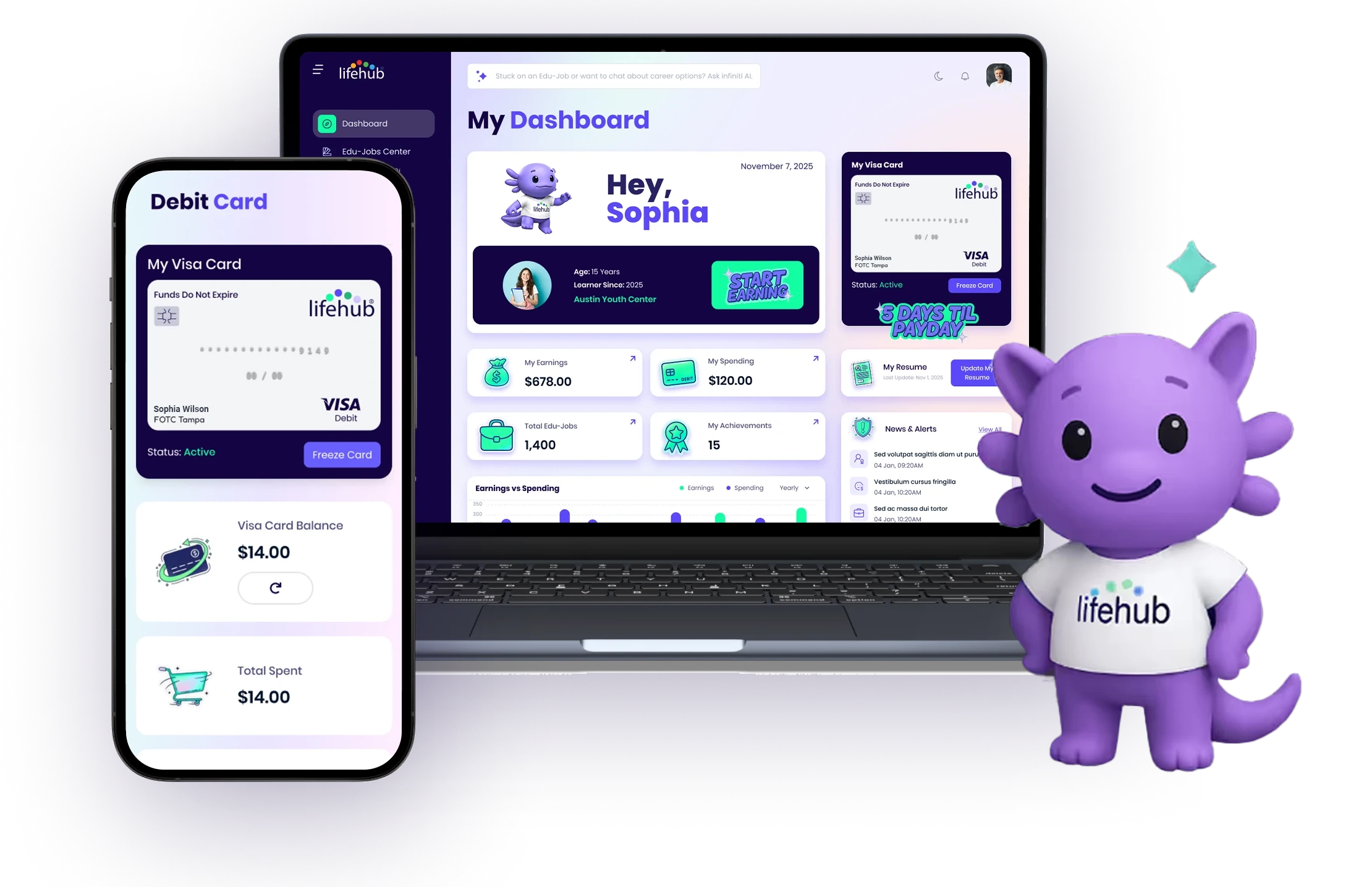
Building real-world financial capability requires practice with actual transactions. Platforms like Life Hub complement traditional banking by connecting earnings to skill development, creating a direct link between learning and financial rewards.
Establish clear expectations about what the wells fargo minor debit card can be used for. Some families restrict usage to specific categories, while others provide full autonomy with periodic reviews.
Common boundary-setting approaches:
These boundaries should reflect your family values and your teenager's maturity level. Adjust them as your child demonstrates responsible decision-making.
The wells fargo minor debit card represents one approach to youth banking. Other options may better fit your family's needs depending on your priorities.
| Feature | Wells Fargo Teen Checking | Alternative Teen Banking Apps | Prepaid Cards |
|---|---|---|---|
| Monthly Fee | $0 for ages 13-24 | Often $0 or $3-5 | Varies widely |
| Parent Controls | Through joint ownership | Robust app-based controls | Limited to load amounts |
| Financial Education | Branch resources available | Built-in learning modules | Minimal |
| ATM Network | Extensive Wells Fargo network | Varies by provider | Limited |
| Earning Opportunities | Limited | Sometimes integrated | None |
Wells Fargo's Clear Access Banking offers another pathway for teens who may need help avoiding overdraft fees. This account type prevents overdrafts entirely by declining transactions that exceed the available balance.
When opening a wells fargo minor debit card, parents should understand how financial institutions handle minor information. Wells Fargo's privacy practices for minors comply with the Children's Online Privacy Protection Act (COPPA).
As a joint account holder, parents have full access to all account information and transaction history. This access continues until the minor reaches age 18 or the account structure changes.
The minor typically gains full account control when they turn 18. At that point, Wells Fargo may convert the account to a standard checking account, or the young adult may choose to open a new individual account.
The wells fargo minor debit card does not directly build credit history. Debit cards draw from available funds rather than extending credit. However, responsible debit card management establishes positive financial habits that support future credit-building activities.
Some families add their teenager as an authorized user on a credit card around age 16 or 17. This strategy can help establish credit history, but it carries different risks than debit card usage.
Understanding when and how to use a wells fargo minor debit card helps teenagers navigate real-world situations with confidence.
Many teens use their debit cards for legitimate school expenses:
Having a debit card eliminates the need to carry cash and provides a clear record of school-related spending. This documentation can be helpful for budgeting and tax purposes if applicable.

When teenagers start working, a wells fargo minor debit card provides a destination for direct deposit. Employers can route paychecks directly to the account, introducing young people to standard payment practices.
This setup also creates opportunities to practice percentage-based budgeting. Many financial experts recommend the 50/30/20 rule, though teens might adjust these percentages based on their circumstances.
Life Hub's approach to youth earnings connects completed learning tasks with real compensation, teaching the relationship between skill development and financial reward. This model complements traditional employment by offering more flexible earning opportunities.
Using a wells fargo minor debit card comes with predictable challenges. Preparing for these situations helps parents guide their teenagers through difficult moments.
Card loss happens frequently with young people. Wells Fargo allows immediate card deactivation through the mobile app or by calling customer service.
Steps to take when a card goes missing:
Replacement cards typically arrive within 5-7 business days. Some branches may issue temporary cards while the permanent one is in transit.
Even with monitoring, teenagers may attempt purchases that exceed their available balance. Wells Fargo handles these situations based on the account settings the parent has chosen.
Options typically include declining the transaction, allowing it with an overdraft fee, or linking to a savings account for overdraft protection. Most parents choose to have transactions declined rather than pay fees.
Teenagers face constant social pressure around spending. Friends may suggest restaurants, activities, or purchases that don't fit the budget.
Role-playing these scenarios before they occur helps teenagers prepare responses. Practice phrases like "That's not in my budget right now" or "I'm saving for something else" until they feel comfortable using them.
The wells fargo minor debit card offers maximum value when integrated into a broader financial education strategy.
Set aside time each month to review the account together. Look for patterns, celebrate smart decisions, and discuss areas for improvement.
Questions to guide the conversation:
These discussions build financial self-awareness and critical thinking skills that extend far beyond banking.
Financial literacy connects to nearly every area of life. Help your teenager see how budgeting relates to their interests and future goals.
A teenager interested in gaming might calculate how many hours of work equal one new game. Someone planning for college can practice researching costs and building savings plans.
Resources for financial education can supplement hands-on banking experience with structured learning about money management, investing basics, and career planning.
As your teenager demonstrates responsible use of their wells fargo minor debit card, you can introduce more advanced financial concepts.
Help your teenager open a linked savings account to practice paying themselves first. Even small amounts transferred regularly build the savings habit.
Discuss how interest works and why keeping money in savings accounts generates (modest) growth over time. Calculate how much a specific goal requires in monthly savings.
While the wells fargo minor debit card itself doesn't involve investing, conversations about using money to generate more money naturally arise from banking discussions.
Some parents open custodial investment accounts (UTMA or UGMA accounts) when their teenager shows interest. These accounts allow minors to own stocks or funds under adult supervision until they reach the age of majority.
Modern teenagers need to understand how debit cards integrate with digital payment systems beyond simple card swipes.
The wells fargo minor debit card can typically be added to mobile payment platforms like Apple Pay or Google Pay. These tools provide additional security through tokenization and biometric authentication.
Peer-to-peer payment apps like Venmo or Zelle allow teenagers to split costs with friends or receive money from family members. Parents should discuss appropriate use of these platforms and review their privacy settings.
Teenagers often shop online before making in-store purchases. Discuss safe online shopping practices:
These skills protect their current accounts and prepare them for managing finances independently.
The wells fargo minor debit card relationship changes significantly when your child turns 18. Understanding this transition helps both parties prepare for the shift.
Wells Fargo typically offers several paths when the minor reaches adulthood:
Each option has different implications for oversight, fees, and account features. Discuss which path makes sense based on your young adult's financial readiness and independence level.
Many parents continue providing financial guidance even after their child turns 18. The structure simply shifts from mandatory oversight to requested advice.
Some families maintain joint accounts through college years to simplify tuition payments and emergency support. Others prefer clean financial separation with periodic check-ins about budgeting and money management.
Opening a wells fargo minor debit card creates opportunities for practical financial education through real banking experiences. When parents combine account access with intentional teaching, teenagers develop money management skills that serve them throughout life. Life Hub takes this learning further by connecting skill development across academics, career readiness, and financial literacy with real earnings that deposit directly to a debit card, creating a motivating link between effort and reward that prepares young people for financial independence.


Whether you're parents, or a homeschool family, Life Hub is your partner to help you
raise super strong kids.

Turning high value micro-learning into real-world cash and non-cash rewards with tokenization.

.svg)



Electus Global Education Co, Inc. has received support from the American Heart Association’s Social Impact Funds.
.svg)
.svg)
.svg)

.svg)
